How Many Keywords Should You Target Per Page? (Contractor SEO Guide)
Wondering how many keywords to target per page on your contractor website? Discover the exact keyword mapping strategy to capture high-ticket local jobs without hurting your rankings.

When contractors build a website, they often make a costly mistake: they dump every service they offer—roofing, siding, gutters, window repair, and emergency tarping—onto a single page, hoping Google will somehow sort it out.
If your website isn't bringing in consistent phone calls, a disorganized keyword strategy is usually to blame. When you try to make one page rank for ten completely different services, Google gets confused, your rankings stall, and your competitors capture the high-ticket local jobs.
Optimizing your website in 2026 requires understanding exactly how to map keywords to specific pages. In this guide, we will break down the exact number of keywords you should target per page, how to group them by search intent, and how to structure your contractor website to maximize your incoming lead volume.
Quick Answer: The Ideal Number of Keywords Per Page
For maximum SEO performance, you should target 1 Primary Keyword and 2 to 4 Secondary (Semantic) Keywords per page.
- The Primary Keyword represents the main core service and location (e.g., Roof Replacement Birmingham AL).
- The Secondary Keywords are natural, close variations or sub-services that support the main topic (e.g., new roof cost, residential roofing contractor, local roof replacement company).
Every page on your website must focus on a single, clear topic. Trying to target too many unrelated keywords on a single page breaks your topical authority and lowers your conversion rates.
Why Contractors Must Care About Keyword Distribution
If you are running a local plumbing, HVAC, or remodeling business, your keyword strategy dictates how Google reads your business footprint. Spreading your keywords incorrectly across your site leads to a severe SEO issue called Keyword Cannibalization.
Keyword cannibalization occurs when multiple pages on your website compete for the exact same search term. If you write about "bathroom remodeling" on your homepage, your service page, and three different blog posts without a clear structure, Google won't know which page is the authority. Instead of ranking one page in the top 3, Google will constantly rotate your pages in the search results, causing your rankings to fluctuate wildly and drop.
By assigning a dedicated, unique set of keywords to each individual page, you give Google a clear map of your business, ensuring the right page shows up when a customer is ready to hire you.
Benefits of Strict Keyword Mapping for Home Service Sites
Limiting and mapping your keywords carefully delivers immediate performance upgrades to your entire digital marketing funnel:
- Higher Relevancy Scores: When a homeowner searches for "metal roofing" and lands on a page dedicated exclusively to metal roofing (rather than a generic construction page), they find exactly what they want. Google recognizes this high engagement and rewards you with higher rankings.
- Domination of the Local Pack: Proper keyword mapping helps you tie specific geographic modifiers to your service pages, which sends clear local SEO signals to your Google Business Profile.
- Clearer User Intent: It allows you to separate users who are just looking for information (e.g., how to fix a leaky faucet) from users who have immediate commercial intent (e.g., emergency plumber near me).
Step-by-Step: The Keyword Selection and Grouping Process
How do professional search marketers organize keywords for a construction or home service website? We use a process called Keyword Clustering. Here is how you can do it for your business:
1. Identify Your Anchor Service (The Primary Keyword)
Start by choosing the main service you want to book. For example, if you are an HVAC contractor, your primary keyword for a core service page might be AC Repair Houston. This keyword usually has the highest local search volume and direct commercial intent.
2. Gather Supporting Semantic Terms (Secondary Keywords)
Once you have your primary anchor, find 2 to 4 highly related terms that variations of your customers use. For an AC repair page, these would look like:
- Air conditioning repair service
- Fix broken central air
- Emergency AC repair technician
3. Integrate NLP and Entities
Search engines use Natural Language Processing (NLP) to understand context. Google expects an authoritative page about "AC Repair" to naturally mention related entities like refrigerant, compressor, thermostat, condenser coil, and HVAC system. You do not explicitly track these as target keywords, but they must appear naturally in your copy to build topical authority.
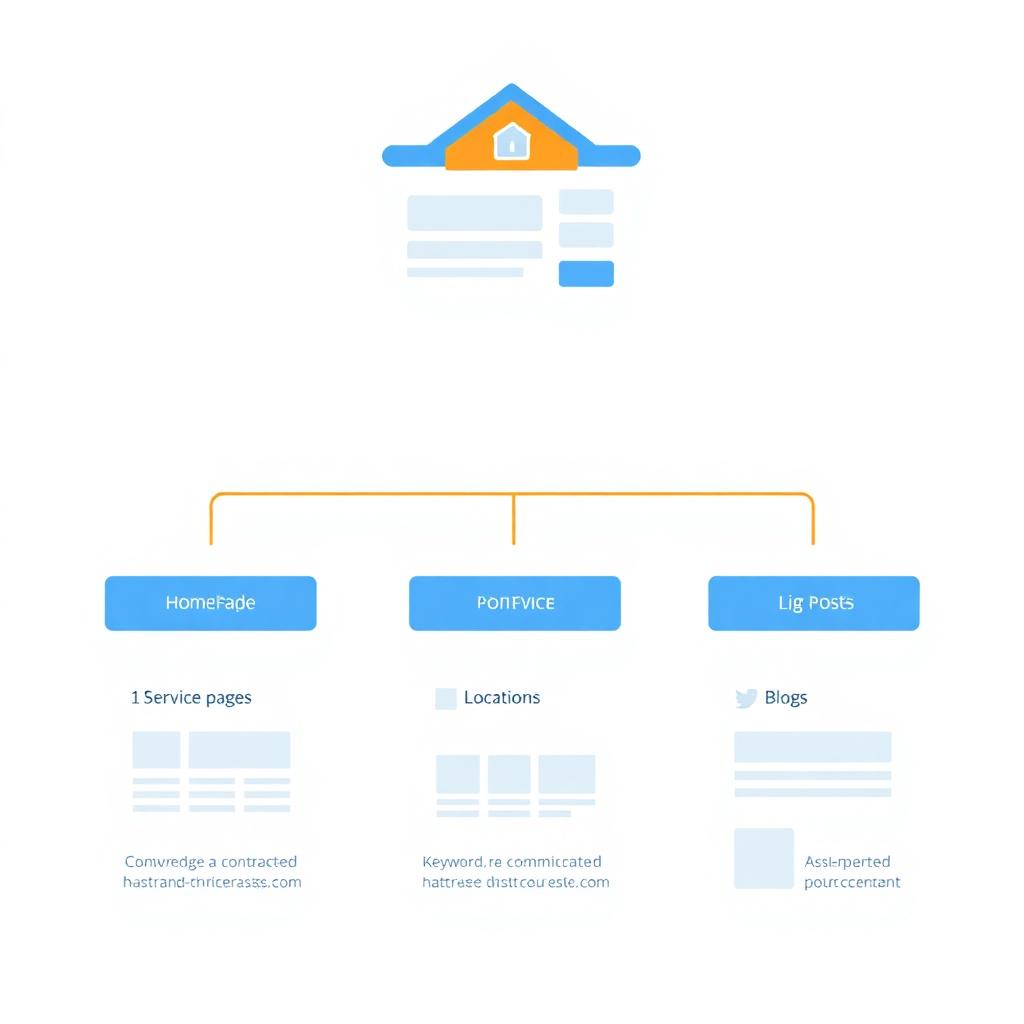
The 4 Core Types of Pages Every Contractor Website Needs
To map your keywords effectively, your website must be organized into a clean structural hierarchy. Here are the four types of pages you need to build:
1. The Homepage (The Brand Hub)
- Target Keywords: Your company name + your main overall industry + your primary city (e.g., Reliable Services | General Contractor in Birmingham AL).
- Purpose: To establish your brand identity and act as a clean directory that routes users and search engines to your deeper service pages.
2. Core Service Pages (The High-Ticket Money Pages)
- Target Keywords: 1 specific service + location per page (e.g., Page A: Commercial Concrete Contractors, Page B: Driveway Installation).
- Purpose: Built exclusively to convert high-intent local traffic into direct phone calls and quote requests.
3. Service Area / Location Pages (The Geographic Catchment)
- Target Keywords: Core Service + Neighboring City Name (e.g., Roof Repair Vestavia Hills AL).
- Purpose: If your physical shop is in one city but your trucks service five neighboring counties, you need dedicated location pages to capture searches in those specific zip codes without cluttering your main service pages.
4. The Blog (The Topical Authority Builder)
- Target Keywords: Long-tail, informational questions (e.g., how often should you update your roof, does a blog help SEO for local businesses).
- Purpose: To answer homeowners' research questions early in the buying cycle, build trust, and pass internal link equity up to your main money pages.
Old SEO vs. Modern Semantic Keyword Clustering
How has search changed? Look at how old-school keyword stuffing compares to modern topic mapping.
| Optimization Element | Old School Keyword Stuffing (Avoid) | Modern Semantic Clustering (Preferred) |
|---|---|---|
| Keyword Density | Repeating the exact phrase "Roofer Miami" 20 times in the text. | Mentioning the primary keyword naturally 2-4 times. |
| Vocabulary | Using only one specific phrase repeatedly. | Using synonyms, related sub-services, and natural NLP entities. |
| Page Structure | Creating separate, thin pages for "Roofing Company," "Roofing Contractor," and "Roofing Services." | Consolidating those identical intents into one comprehensive, high-quality page. |
| User Experience | Hard-to-read text written purely for search engine bots. | Highly scannable, deeply educational content built for real homeowners. |
Pricing and Resource Allocation: What Does Quality Keyword Mapping Require?
Setting up a flawless keyword map requires professional research software and technical expertise.
- The DIY Cost (Time Investment): If you try to map keywords yourself using free tools, expect to spend 10 to 20 hours auditing your site, analyzing competitors, and trying to fix indexing errors.
- Professional Campaign Integration ($750 - $1,500/month): When you invest in a professional Local SEO campaign, complete keyword mapping, internal link restructuring, and competitor keyword tracking are fully included as part of your foundation.
Warning: Be wary of cheap marketing packages that promise to optimize "100 keywords" for a low fee. Legitimate SEO focuses on the right high-intent keywords that drive booked jobs, not a random list of low-volume terms designed to make a monthly report look good.
Why Partner with AIO SEO Expert
At AIO SEO Expert, we don't believe in vanity metrics. We know that as a contractor SEO client, you don't care about generic traffic spikes; you care about your trucks moving and your phone ringing with qualified local leads.
Led by SEO specialist Maznur, our agency uses advanced semantic clustering techniques tailored specifically to the home services industry.
- Clean Structural Strategy: We eliminate keyword cannibalization by building out highly targeted service and location silos.
- Transparent Deliverables: We show you exactly which page is targeting which keyword, how those pages rank, and most importantly, how many conversions they produce.
- Future-Proof Optimization: We optimize your content for Google's AI Overviews, ensuring your business is cited as the premier local authority.
Areas We Serve
We build dominant local search footprints for contractors locally in Louisiana and across international markets. Whether you need to secure the top spot in the local map pack for a single metro area or expand your digital reach across multiple counties and cities, we build the clean internal architecture needed to win.
Keyword Tracking and Maintenance Best Practices
Keyword optimization is not a one-time project. Once your keyword map is built, it requires ongoing management:
- Monitor Search Console: Keep a close eye on Google Search Console to ensure two different URLs are not impressions-sharing for the same high-intent keyword.
- Adapt to Search Shifts: Homeowners change how they search over time. Periodically refresh your secondary keywords to match conversational search patterns and AI trends.
- Keep Content Fresh: Update your core service pages annually with fresh project photos, local customer testimonials, and updated service details to maintain your topical rankings. Run a quarterly SEO audit to catch new issues early.
Frequently Asked Questions
How many keywords per page is best for SEO?
The industry best practice is to target 1 primary keyword and 2 to 4 closely related secondary keywords per page. This keeps the page highly focused on a single topic, which helps search engines crawl it accurately and satisfies user intent.
Do more keywords help SEO performance?
No. Stuffing a page with a high volume of keywords actually hurts your SEO. It dilutes the relevancy of the page, creates a poor reading experience for your users, and can trigger Google's spam filters, leading to a drop in rankings.
What is keyword cannibalization on a contractor website?
Keyword cannibalization happens when multiple pages on your website target the exact same keyword intent (for example, having three separate pages trying to rank for "kitchen remodeling"). This causes your own pages to compete against each other, splitting your ranking power and confusing Google.
Should I create separate pages for "Roofing Company" and "Roofing Contractor"?
No. Google understands that "Roofing Company" and "Roofing Contractor" share the exact same user intent. You should build one comprehensive, authoritative page for your primary roofing service and include those close variations naturally as secondary keywords within the copy.
Ready to Stop Guessing and Start Dominating Your Local Market?
If your website isn't bringing in the high-ticket contracting jobs it should, your page structure is likely holding you back. Stop wasting time guessing which keywords to use and let us build an intentional, high-converting keyword map for your business.
Let's look under the hood of your website and build a roadmap to keep your crews busy year-round.
Book Your Free Technical SEO & Keyword Mapping Consultation Today:
- WhatsApp: +8801767091490
- Email: seoexpertmaznur@gmail.com
- Website: aioseoexpert.com
Frequently asked questions
Q1.How many keywords per page is best for SEO?
The industry best practice is to target 1 primary keyword and 2 to 4 closely related secondary keywords per page. This keeps the page highly focused on a single topic, which helps search engines crawl it accurately and satisfies user intent.
Q2.Do more keywords help SEO performance?
No. Stuffing a page with a high volume of keywords actually hurts your SEO. It dilutes the relevancy of the page, creates a poor reading experience for your users, and can trigger Google's spam filters, leading to a drop in rankings.
Q3.What is keyword cannibalization on a contractor website?
Keyword cannibalization happens when multiple pages on your website target the exact same keyword intent (for example, having three separate pages trying to rank for "kitchen remodeling"). This causes your own pages to compete against each other, splitting your ranking power and confusing Google.
Q4.Should I create separate pages for "Roofing Company" and "Roofing Contractor"?
No. Google understands that "Roofing Company" and "Roofing Contractor" share the exact same user intent. You should build one comprehensive, authoritative page for your primary roofing service and include those close variations naturally as secondary keywords within the copy.
Louisiana SEO Expert
Maznur Rahman helps Louisiana contractors and service businesses rank #1 on Google Maps and organic search. Over 10 years in SEO, 200+ projects shipped.
Discussion (0)
Be the first to leave a comment.